

Coding agents got good fast for a reason: code comes with its own verifier. It compiles or it does not, the linter complains, the tests pass or fail. Math has a version of the same thing in formal proof. Most real-world work has nothing like it. So to build an agent for it, the first job is to build the verifier. Once it exists, the rest becomes a search you can pay for.
Frontier labs have been talking about recursive self-improvement (RSI) of models for a while. This post is a small, real example of trying RSI on an agent: the first version of a fashion video agent, which we built in about a week of work. We never trained or fine-tuned a model. What kept improving was the harness around the models: the scripts, prompts and rules.
The task: a fashion video straight from the product page
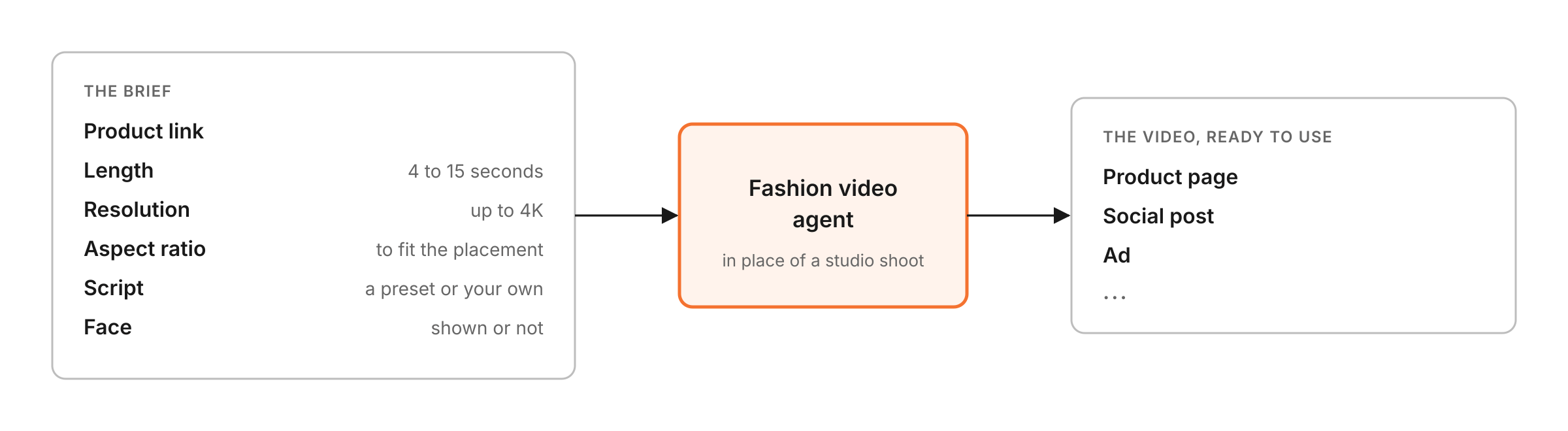
A brand gives a studio a product and a brief: how long, what format, what the camera should do. The studio gives back a video that goes on a product page, in a social post or in an ad. Our agent takes the same brief. A product link and the video requirements (length, resolution, aspect ratio, script) go in. A video that can be used as delivered comes out.
A task like this has no ready-made verifier. Nothing about a good fashion video compiles:
Material. The fabric has to drape and catch the light like the real thing.
Detail. Prints and logos have to stay exact in every frame.
Unseen angles. Angles that no photo shows have to be inferred and still be right.
Camera. It has to move like a camera.
Face. When the brief says no face, not even a chin may show.
Asking a video model directly does not get there either: a single take is rarely right on every count.
Building the verifier
We did not design the verifier up front. We watched videos first, and the rubric came out of what we saw. Two kinds of material went in. Videos that brands had made themselves showed what good looks like. The video agent’s own first attempts showed how it goes wrong.
The verifier is an agent too, and it was not right the first time. I iterated it together with the coding agent: run it on real videos, look at what it got wrong, fix it. The very first video was a slideshow, and the verifier passed it: the judge was a vision model looking at 16 still frames, and stills cannot show motion. So we added a motion check that measures every frame with ffmpeg. Another video put the model in a black tee where the brand’s photos had a white shirt, and it passed too, so styling became its own check. In the first two days we ran it ten times, and every run ended with a fix to the verifier.
The verifier needs checking too. For the motion check, we labeled 29 of the video agent’s attempts by hand, frame by frame, working with the coding agent: where each cut falls, where the picture fades or freezes. Against those labels, the check finds 60 of the 61 cuts and reports none that are not there.
The result is seven checks of two kinds: measurements made by code, and a judge, a vision model that scores what code cannot measure. Each check answers a question a person would ask before sending the video to a client.
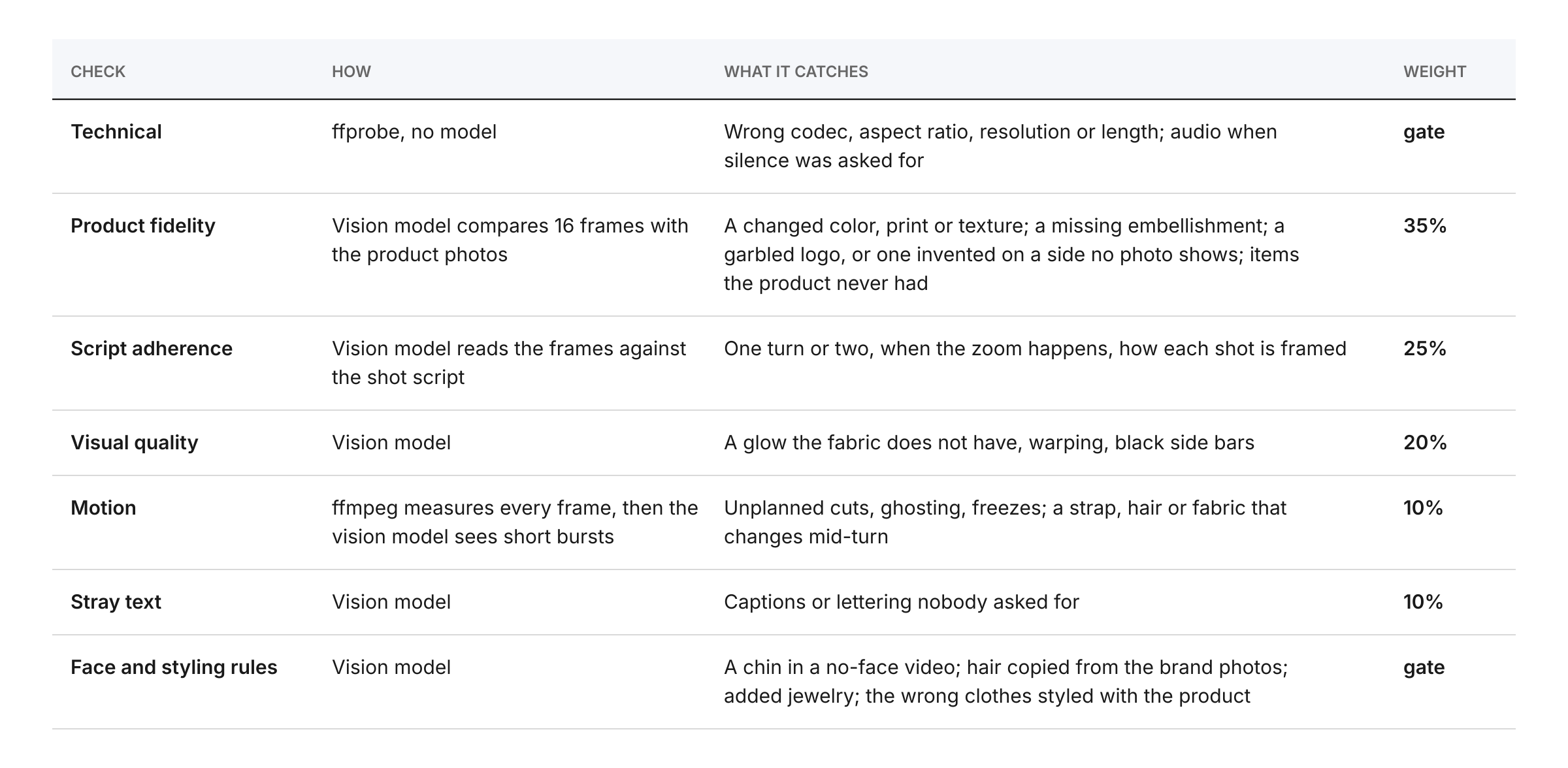
The weighted checks add up to a score out of 100. We set the weights from experience, as a first version to iterate on like the rest of the verifier. A take passes at 75 or more, and only if no gate fails: a 92 with a chin showing in a no-face video still fails.
Two rules keep the verifier honest. First, a measurement beats an opinion. ffmpeg knows exactly where the cuts are, so when the vision model complains about a cut the script asked for, its verdict is rejected and it has to judge again. Second, the judge never grades its own work. It runs as a separate agent from the one that writes the prompt and makes the video.
From verifier to video agent
With the verifier in place, making the fashion video agent comes down to two loops around it: one that makes each video, and one that makes the agent better.
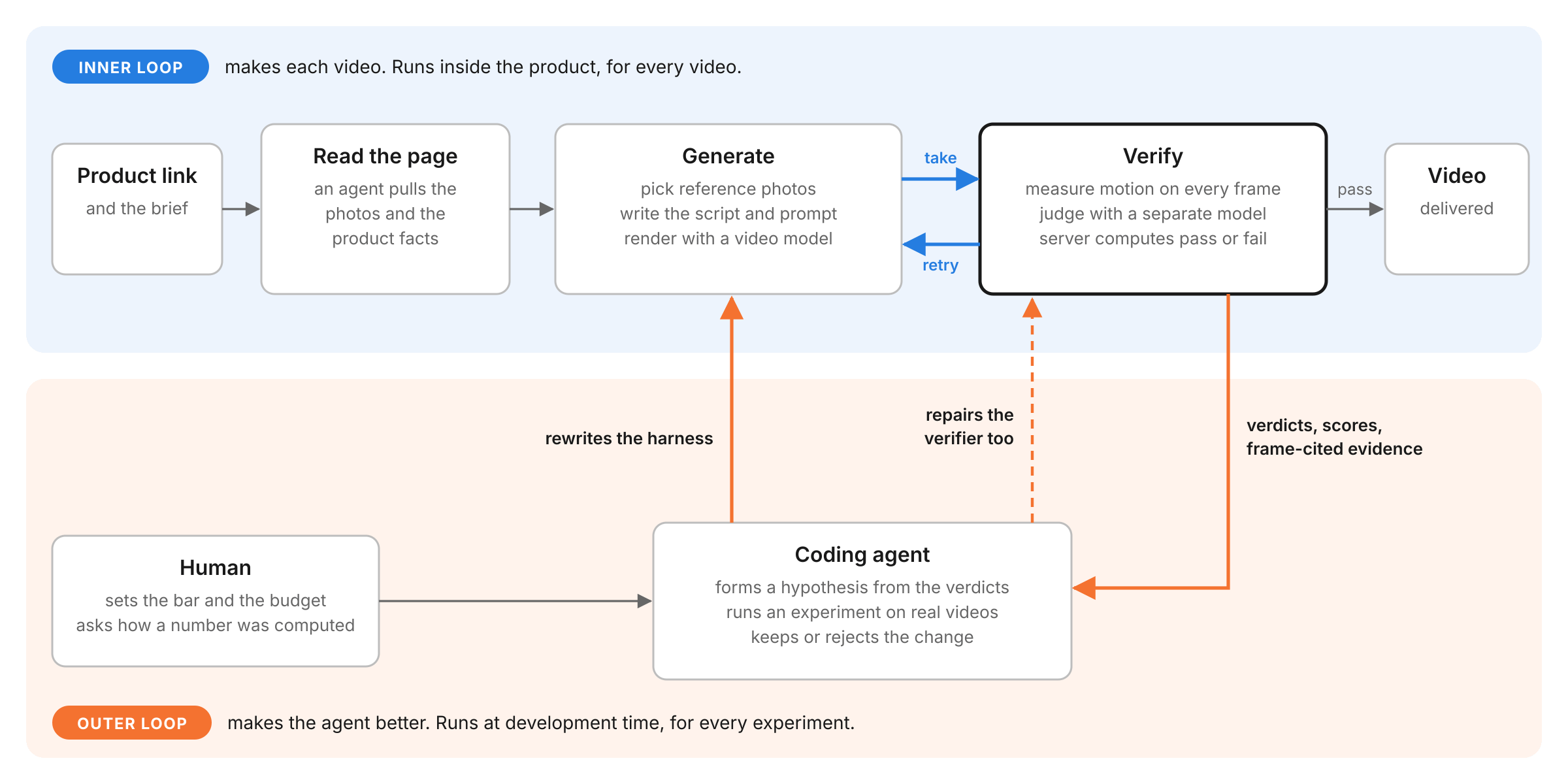
The inner loop is the product. First an agent reads the product page and pulls the photos and the product facts. Then the loop generates a take, verifies it, and retries with the judge’s notes when the take fails. The outer loop is where the self-improvement happens, and a coding agent runs it (I used Claude Code). It works the way a researcher would: read the verdicts, form a hypothesis about what is going wrong, change the harness, run an experiment, and keep the change only if the scores hold up. The harness is everything it can change: the scripts, the prompts, the choice of reference photos, the retry rules. The video model and the judge model both stay frozen. The harness improves from the output of its own verifier.
The first version ran on a cloud video model. The chart shows the outer loop at work there: take after take of the same videos, with the coding agent fixing the harness in between.
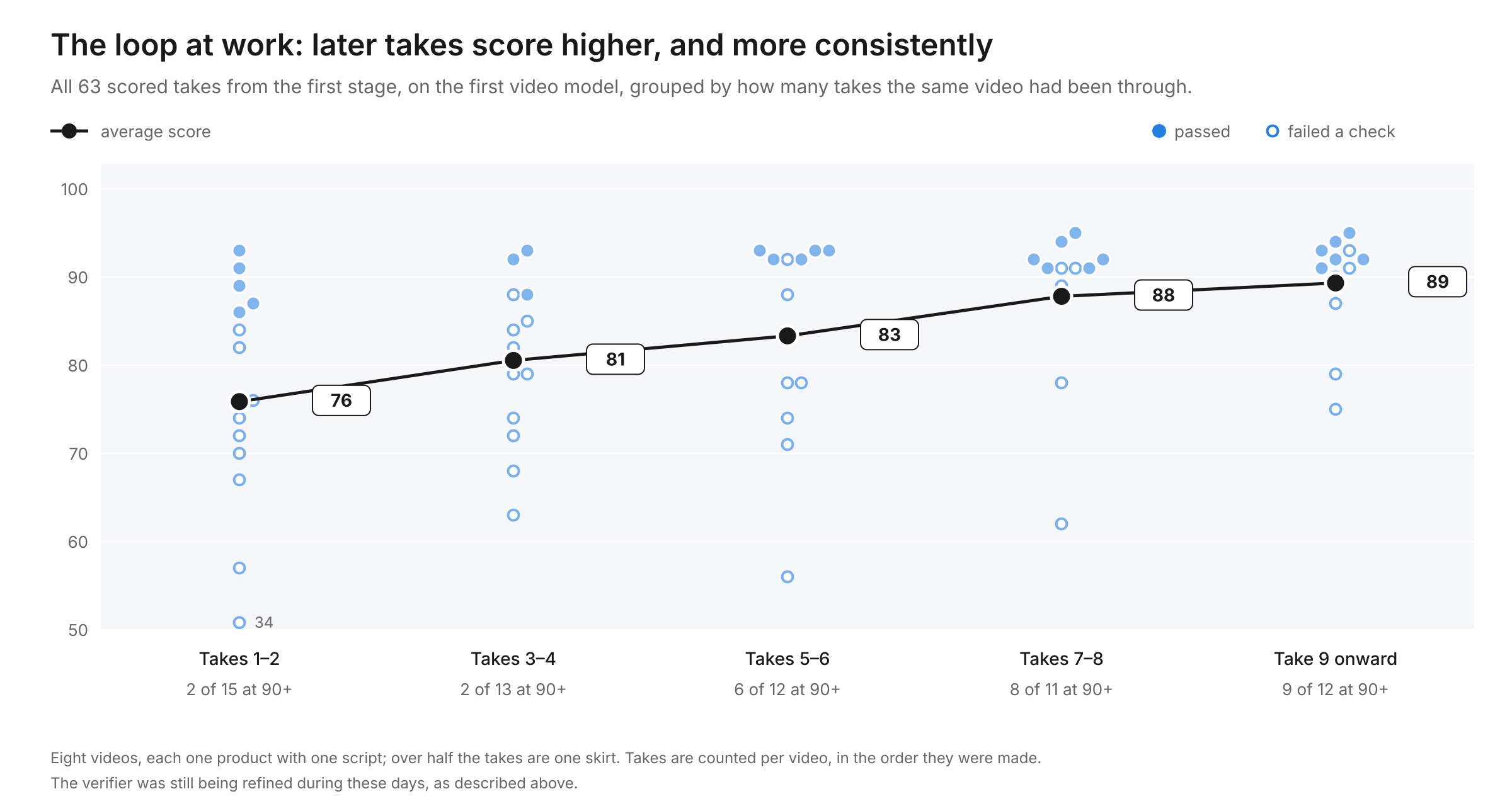
Across all 63 takes of that stage, the first two takes of a video averaged 76, and 2 of 15 reached 90. From the ninth take on they averaged 89, and 9 of 12 reached 90.
Three examples of that loop at work:
It fixed the scripts. The verifier kept flagging ghosting whenever a script asked for one long shot that moves from wide to close-up. The coding agent rewrote those scripts as separate shots with hard cuts. One product’s score went from 46–70 to 94.
It fixed the inputs. In videos meant to hide the model’s face, a chin kept showing at the top of the frame. The coding agent traced it to the reference photos: they were cropped right at the chin, and the video model copied that framing. It cropped the photos lower, and the chin showed up less often.
It threw out its own bad ideas. The coding agent tested each change on the same 8 products, 16 videos per test, and dropped the ones that did not raise the score. Among them: rendering on a taller canvas and cropping the face out, tighter framing, two extra defect detectors and three ways to upscale.
A second model in a day
The verifier showed its value when we added a second video model, a self-hosted one. The two models need different prompts, different inputs and a different flow. My brief to the coding agent came down to this:
Same input, same verifier, everything else new. Run the same loop we ran on the first model, and keep improving and regenerating until it reliably produces the best video it can.
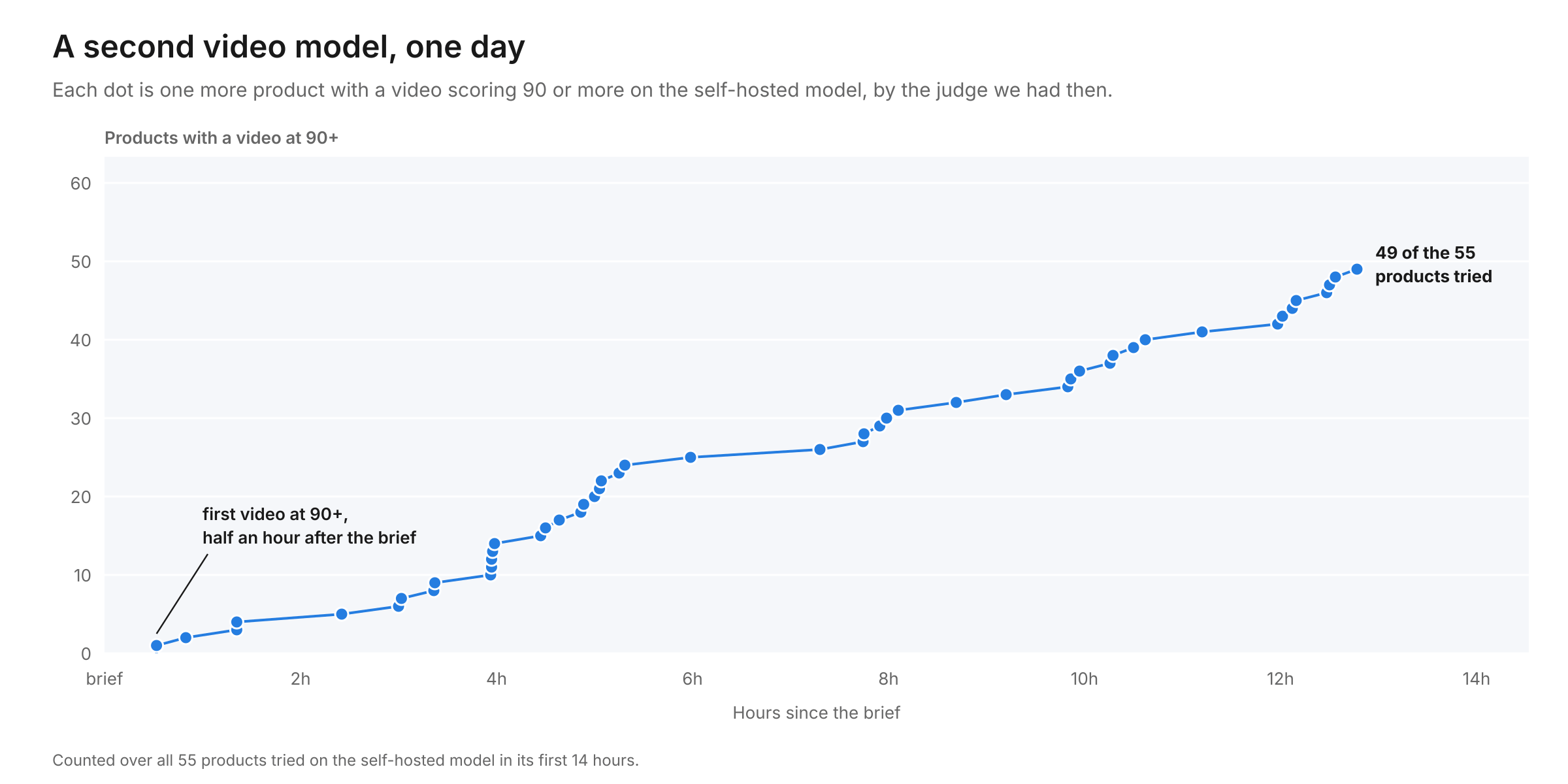
It ran that loop mostly unattended. The longest stretch was 15 hours 31 minutes. Thirteen hours after the brief, 49 of the 55 products it had tried had a video scoring 90 or more, by the judge we had then. In the final head-to-head round it matched the cloud model: 12 of 14 products against 13 of 14 at 90 or more within two retries. Nobody tuned the second model by eye. The verifier already knew what good looked like, so adding a model was a search.
A stricter judge
Because the verifier is an agent, its model matters. The judge model started as Claude Sonnet 5. Later on, I asked whether a stronger model would do better, so the coding agent had Claude Opus 5.5 re-score 24 videos we already had. Nothing else changed: same frames, same measurements, same instructions.
The new judge was stricter, and it showed why. It caught things the old judge had missed: a phone and wallet spilling out of a bag that has neither in the product photos, a jacket that vanishes between shots, a chin at the top of a no-face video. Scores fell 7 points on average, and the pipeline that had 15 of 16 videos passing at 85 or more now had 5. The videos were no worse. The judge had stopped missing things.
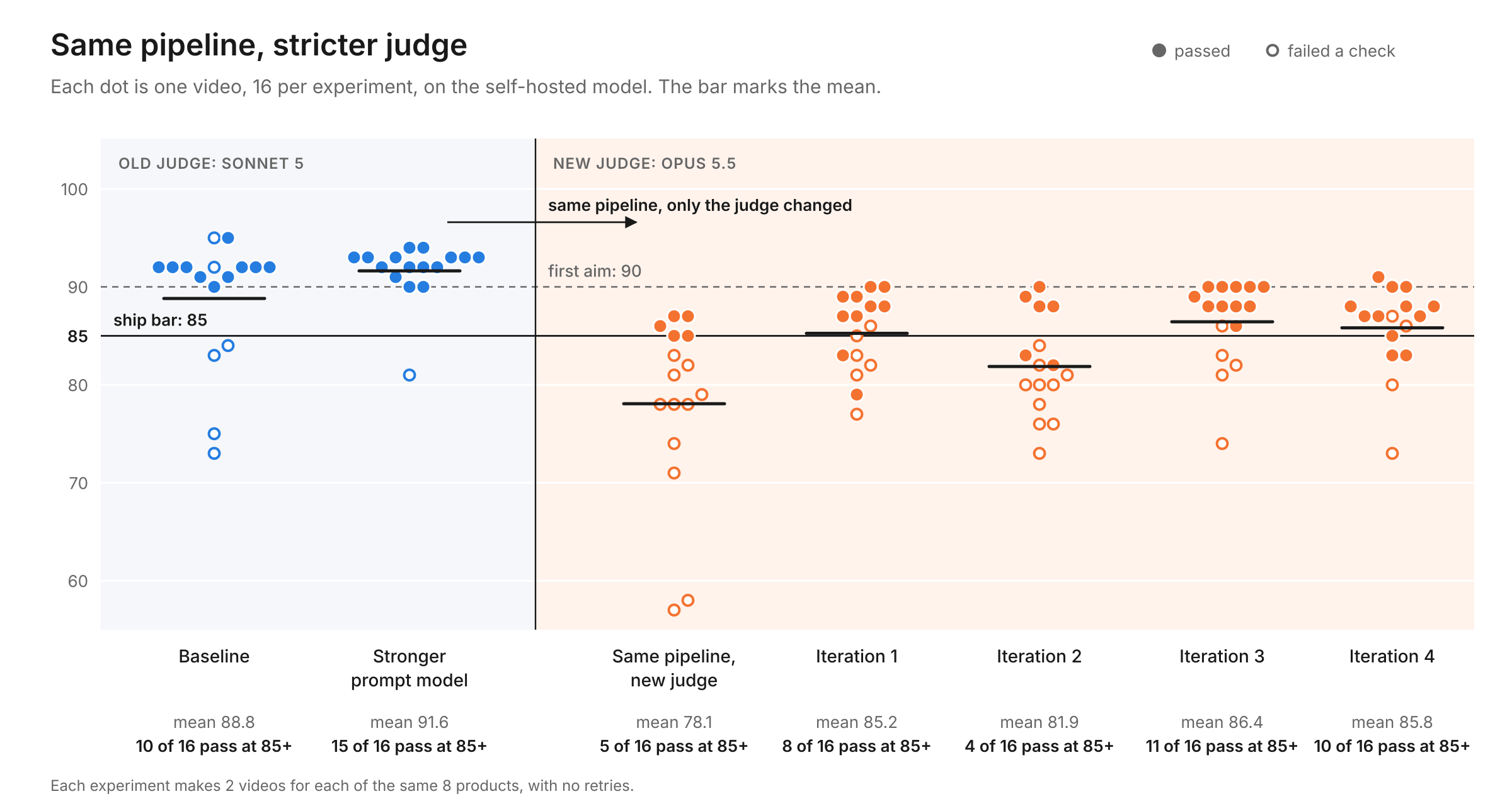
So the coding agent went back into the loop with the stricter judge and fixed what it had exposed. Videos passing at 85 or more went from 5 of 16 to 11 of 16.
We had aimed at 90 and landed at 85 to 89. That turned out to be enough: an 85 from the new judge is roughly a 92 from the old one, and clients accept it. So 85 is the bar we ship on. It is not perfect: about a third of first takes still miss it and need a retry.
The experiment in numbers
About 120 commits of iteration, all written with Claude Code.
701 rendered takes of 65 products on the two video models.
26 experiments, from head-to-head rounds to A/B tests of 16 videos each.
23 revisions of the judge’s instructions and 29 hand-labeled videos.
Video generation: about $900 worth of cloud rendering, and roughly 60 GPU-hours on two H200s for the self-hosted model.
Agent and judge calls in the inner loop: about $200.
The coding agent in the outer loop: an estimated $500 at API prices.
Verifier first
The recipe is short. Build a verifier you would trust to sign off the work. Put a loop around it. Then let a coding agent improve the harness against it, and spend tokens. We trained no model, and the video agent kept getting better, because each round of verdicts fed the next version of the harness. That is RSI on the harness.
The verifier is also the ceiling. An agent climbs whichever hill the verifier draws. With a loose judge, ours stopped at videos that only looked finished. With a better judge, it kept going. Models get better on someone else’s schedule, and a coding agent can rebuild a harness overnight. The verifier is the part that holds what you mean by good. Build it first.
Citation
Please cite this work as:
Feng, Qing. “verifier is all you need”. nemofq.com (Nov 2026). https://www.nemofq.com/p/verifier-is-all-you-need
Or use the BibTeX citation:
@article{feng2026verifier,
  title = {verifier is all you need},
  author = {Feng, Qing},
  journal = {nemofq.com},
  year = {2026},
  month = {November},
  url = "https://www.nemofq.com/p/verifier-is-all-you-need"
}